Registration for the conference is now open. Early bird rates until 15th July, then rates will increase slightly.
Expression of Interest
Anarchademics, Unite!
A two day event for early career scholars
We invite expressions of interest for an upcoming two-day workshop designed for scholars at the beginning of their academic journeys: Master’s and PhD students or those who have graduated recently, whose research engages with anarchism and who are considering a future in academia or beyond. The workshop aims to support particularly those who experience additional barriers, including but not limited to ideology, class, race and ethnic belonging, religion, gender, sexuality, residency status, disability, and any manner of intersections. While these participants are especially encouraged, we warmly welcome interest from anyone whose work and aspirations align with the spirit of the event. We hope to create a collaborative, supportive space for sharing ideas, building connections, and reflecting on different pathways for scholars in anarchism.
Foremost, we in the Anarchist Studies Network (ASN) conference organising team want to invite you to submit your Expression of Interest in this event. The workshops will take place in Manchester on Monday, 24th August and Tuesday, 25th August 2026, and will involve a series of activities led by network members and associates. During the sessions, they will share insights, experiences, strategies,and suggestions for life in (or tangential to) academia regarding teaching practice, pedagogies, funding applications, and other challenges related to anarchist theory and practice within the university setting.
The workshop will be funded by the ASN and we will cover:
- your travel up to £150 return (UK or outside, but please note that the activities are designed for UK academics)
- your accommodation for two nights
- refreshments during the two days of the workshop and one dinner meal
We hope that after the workshop you feel motivated to attend the upcoming ASN conference which will take place in Manchester on 26th-28th August and online on 31st August. Please note that participating in one does not preclude or guarantee participation at the other. If you would like to present a paper at the conference you will need to send a separate abstract using the form on the website.You will need to register for the conference separately and may be required to pay.
The form below offers you the opportunity to detail how you hope the workshop would benefit you. Please fill it in and send to asn.conference@protonmail.com. Please use that email if you have any questions.
On behalf of the ASN organising team, thank you for taking the time to complete the Expression of Interest form.
We aim to respond to all applicants within four weeks of the closing date 20th April, 2026.
Elizabeth, Elke, Jim, and Ray
| Name | |
| Pronouns | |
| Contact Details (email and phone number) | |
| Academic Background | |
| Research Interests | |
| How do you hope to benefit from participating in these workshops? | |
| What are some of the challenges you’ve faced related to academia? | |
| Are there any specific adaptations we can make that would better support your participation in these workshops? | |
| What kind of topics would you like to see discussed in the workshops (i.e. information about publishing, teaching, getting a job, alternatives to academic life, etc)? |
Call for Papers
Anarchist Studies Network Conference 9
26-28th August, University of Manchester, UK
31st August, online
More Than Human Anarchism
What does it mean to think, feel, and act in more than human ways? How do anarchist theories and practices shift when rivers have rights, when forests resist extraction, when animals are political subjects, when humans extend beyond the biological, when technologies act against us, and when the Earth itself becomes an active participant in struggle? Can anarchism truly be anarchism if it is anthropocentric? Or does anarchism already contain within it the seeds of a profoundly more‐than‐human worldview?
More-than-human anarchism can be framed as a site of tension (anarchism rejecting more-than-human elements), as a politics of relation (anarchism with the more-than-human), as a philosophical and ethical orientation (anarchism as more-than-human), or as a horizon that exceeds current categories entirely (anarchism beyond the human).
When anarchism is understood as a response to the more-than-human, scholars and activists may focus on suspicions of corporate-owned Generative AI, or resisting ecological devastation, confronting extractive capitalism, building multispecies justice practices, or engaging in environmental direct action from land defence and climate sabotage to community rewilding, herbal medicine and decolonial ecological education.
More-than-human can also be a catalyst for anarchist organising and imagination – nonhuman solidarities invoked in ecofeminist and Indigenous anarchisms, the tactical affinity with landscape and place in guerrilla and clandestine struggles, or the vibrant cultures of punk, art, and literature that celebrate animals, ecosystems, and the Earth as co-conspirators in revolt. Cyberpunk imaginaries encourage us to think about humanity in synthesis with technology and the digital sphere, and even under the current dominance of tech-oligarchies activists continue to scrape out spaces to explore more-than-human technologies,
Going further, anarchism may be understood as a philosophy rooted in a world of interdependent beings, entangled agencies, and lively materialities. The social is never purely human; political life emerges from innumerable relational forces, animate and inanimate, whose tensions, cooperations, and frictions constitute the fabric of existence. Any attempt to reduce this polyphony to a single dominant logic risks reproducing the hierarchical patterns anarchism seeks to abolish.
Finally, anarchism itself can be a site of conflict and creativity when approached from a more-than-human perspective: How do individualist, social, green, queer, Indigenous, posthuman, and eco-anarchisms collide, overlap, or mutually inform one another? How might anarchist commitments be reconfigured when moving from human liberation to multispecies flourishing? Or even to post-human evolution beyond our biological limitations?
To explore these provocations, the 9th International Conference of the Anarchist Studies Network invites paper submissions addressing More-Than-Human Anarchism as a central theme.
Below is a non-exhaustive list of suggested topics. Anarchist engagements with the more-than-human might include:
- multispecies justice, ecological mutual aid, and kin-making practices;
- anarchist critiques of anthropocentrism, human supremacy, and the category of “the human”;
- Indigenous anarchisms, land-based politics, and decolonial ecological relations;
- animal liberation, vegan anarchism, and interspecies solidarities;
- eco-anarchist strategies, including land defence, sabotage, and prefigurative ecological alternatives;
- posthumanist, new materialist, and animist approaches to anarchist thought;
- the political agency of landscapes, weather, infrastructures, or technologies;
- climate breakdown, disaster response, and anarchist ecological organising;
- queer ecology, crip ecology, and anarchist challenges to normative human embodiment;
- rewilding, permaculture, and anarchist experiments in multispecies commons;
- the role of nonhuman forces in social movements, uprisings, and everyday life;
- speculative anarchist futures including solarpunk, bioregionalism, and multispecies world-building.
- potential uses of Generative AI towards anarchist ends;
- grassroots tech collectives and the alternative technological worlds they envision and build;
- cyberpunk imaginaries or human/tech synthesis and digital worlds built by us and for us;
If you find yourself Less-Than-Interested in these suggestions, you are welcome to propose a paper or panel related to anarchist theory and practice that has less to do with the conference theme.
We welcome submissions from scholars, activists, artists, and all those exploring or experimenting with more-than-human anarchism, but please note that knowledge-sharing is an essential component of the conference.
Panels and streams on a particular theme are welcome, as are non-traditional presentation formats, such as performances, exhibitions, workshops, among others. Abstracts should be sent in English (but we accommodate papers in any language). Please indicate if you wish to present in a different language.
Abstracts should be no more than 350 words and need to be send by 31st March 2026 via the following form:
Please indicate whether you want to present in person or online. In case of the latter, please also indicate your time zone. The in-person conference will take place in University of Manchester, UK, 26-28th August. Online day will take place on 31st August. We are likely to be able to support a small number of participants with travel and accommodation costs. Please indicate whether you will need support and a rough estimate of your expenses, should you need it.
Please do get in touch with any specific questions, needs or comments and we will do our best to meet them. We can be found at asn.conference@protonmail.com.
CfP: ASN 8 – Anarchism in/with/as/beyond CONFLICT
Is conflict a problem to solve, an awkward fact of life, or even a virtue to uphold? Are particular conflicts ‘good’ or ‘bad’? Is anarchism in conflict with itself? Does peace simply equate to an absence of conflict, or is it an ‘equilibrium’ of conflicting social forces? War, huh? What is it good for? ‘Absolutely nothin’!’ (Edwin Starr, 1970).
Conflict exists at all levels of society, in myriad forms, and with wildly diverging intensities. Anarchism can be framed as the site of conflict (anarchism in conflict), as the cause of conflict (anarchism with conflict), as a philosophy and practice of conflict (anarchism as conflict), or as the response to conflict (anarchism beyond conflict).
When anarchism is a response to conflict, conflict is often understood as a problem to be overcome – think for example of systemic oppressions and coercive hierarchies, interpersonal or civil dispute resolved through transformative justice, or anti-war and anti-militarist organising campaigns.
As a cause, conflict has also been embraced as a core tenet and activating force of anarchist organising and culture – think of the in-your-face antagonism of class war, the ‘willingness to offend’ that animates queer punk cultural interventions (Wiedlack, 2015 [Queer-Feminist Punk: an anti-social history]), or the celebrated militias of Makhno, Durruti and their ilk.
Going further, anarchism may be understood as a philosophy and practice that perceives the essence of social interaction as an unending plurality of conflicts, drawing on the classical anarchist invocation of antinomies:
Out of these antinomies, their conflicts and precarious equilibrium, comes growth and development; any fusional resolution or the elimination of one of the terms would be the equivalent of death. (Proudhon, 1866 [Théorie de la propriété – Diane Morgan’s translation])
Finally, anarchism itself can be the site of conflict given its diverse and heterogenous character. Think of the non-violent approaches to activism versus propaganda by the deed, but also the clashes between the different philosophical groundings of anarchism(s). At times, anarchism also replicates geopolitical divisions.
To explore these tentative sketches in greater detail, the 8th International Conference of the Anarchist Studies Network invites paper submissions addressing Anarchism in/with/as/beyond CONFLICT as a core theme (hosted at Ulster University Belfast, 4th-6th September 2024 – check accessibility here).
To offer a (not exhaustive) list of suggested topics, anarchist engagements with conflict might encompass:
- the fight against systemic oppressions;
- armed struggle, non-violent resistance and pacifism;
- conflict transformation (such as transformative justice or anti-carceral conflict resolution);
- philosophies of antinomy or agonism (and critiques of Hegelian dialectics);
- the back catalogue of anarcho-punk band, Conflict;
- interpersonal relationships at home, at work, at play or in the street;
- ‘no war but the class war!’ – discuss;
- anarchist analyses of post-conflict and deeply divided societies;
- the conflicted self and anarchist approaches to psychoanalysis/psychology/psychiatry (including critiques of ‘wellness’ and self-care);
- repertoires of protest and strategic arguments amongst social movements;
- ‘the culture war’;
- inter-state or intra-state militarised combat (termed as war, civil war, invasion, ‘special operation’, or conflict).
Or, if you find yourself in conflict with this list, you might prefer to propose a paper related to anarchist theory and practice that has nothing to with the main topic at all – feel free!
Panels and streams on a particular theme are welcome, as are non-traditional presentation formats, such as performances, exhibitions, workshops, among others. Abstracts should be sent in English (but we accommodate papers in any language).
Abstracts should be sent by 30 March 2024 to asn.conference@protonmail.com. Please indicate whether you want to present in person or online. In case of the latter, please also indicate your time zone. Please do get in touch with any specific questions, needs or comments and we will do our best to meet them.
Translations:
Español / Русский / Deutsch / Ελληνικά / Italiano / Kurdî / Português / عربي / Français
ASN 7 Anarchist Futures
Call for Contributions: Anarchist Essays Podcast
The ‘Anarchist Essays’ podcast was launched in September 2020 by Loughborough University’s Anarchism Research Group (ARG) and the journal Anarchist Studies. The series currently comprises 40 episodes which have been downloaded over 20,000 times in over 89 countries.
We have recently secured funding from The Lipman-Miliband Trust to support a series of paid contributions to the podcast from individuals in communities typically underrepresented in academia. To that end, we are seeking 5 ‘essays’ from individuals who may face barriers to inclusion in academia, including, but not limited to: scholars from BAME backgrounds; LBGTQI+ and non-binary scholars; disabled scholars and scholars marginalised due to economic class or other factors.
A typical episode of the podcast lasts 15 minutes (approximately 2000 words) and an honorarium of £150 will be paid for each contribution. These episodes will be released in December and January 2022/3.
If this is of interest, please send essay proposals of no-more than 150 words to Matthew Adams (m.s.adams@lboro.ac.uk) by 1st September 2022. There are no restrictions on the topic of the essays, but applicants are encouraged to listen to previous examples to gauge tone and content. Successful applicants will be notified by October 2022 and arrangements made for recording their essays.
20 Years of Anarchist Studies
Jesse Cohn, Kathy Ferguson, Ruth Kinna, Saul Newman & Alex Prichard
Call for Papers: Anarchist Futures
This roundtable explores the history, purpose and some of the insights and innovations in Anarchist Studies over the past fifteen years. It was recorded for submission to the Political Studies Association’s 2022 online conference, and features five longstanding members of the Anarchist Studies Network and the North American Anarchist Studies Network: Jesse Cohn, Kathy Ferguson, Ruth Kinna and Saul Newman. The discussion is chaired by Alex Prichard, co-convenor of the ASN from 2006. The roundtable will be published as a Critical Exchange in Contemporary Political Theory.
Find out more about the Anarchist Studies Network here: https://anarchiststudiesnetwork.org/ The Anarchist Studies Network is a Specialist Group of the UK Political Studies Association.
This video is brought to you by Loughborough University’s Anarchism Research Group. For more information on the ARG, visit https://www.lboro.ac.uk/subjects/poli… .
You can follow us on Twitter https://www.twitter.com/arglboro
Our music comes from Them’uns (featuring Yous’uns). Hear more at https://soundcloud.com/user-178917365
Anarchist Studies Conference 2022 Call for papers
Anarchist Studies Network // 7th International Conference // Online
Call for Papers: Anarchist Futures
Often called idealists, dreamers, unrealistic, anarchists have a complex relationship to the future. We imagine it, theorise it, work for it. We try to bring it to the present. We draw blueprints of what it might be like. We nurture connections that reflect our hopes. We imagine new worlds, living in the future whilst changing the present. However, utopian thought can be considered both an incentive and a discouragement to action. Its complexity and relationship to the future is particularly meaningful for anarchists. After all, how can political thought be fully understood without projecting ourselves and collectively into the future? Anarchist utopias from the early News Of Nowhere (William Morris, 1890) to The Dispossessed (Ursula K Le Guin, 1974) and other recent fiction has underlined the role of imagining the future in order to build a better world.
Anarchist Futures is a call to think about possibilities, gaps and interstices where anarchist futures exist. It is an encouragement to walk the bridge of time and make the future present. It is a hope that we can draw lines of solidarity and community which redefine the current state of affairs so that the future is anarchist.
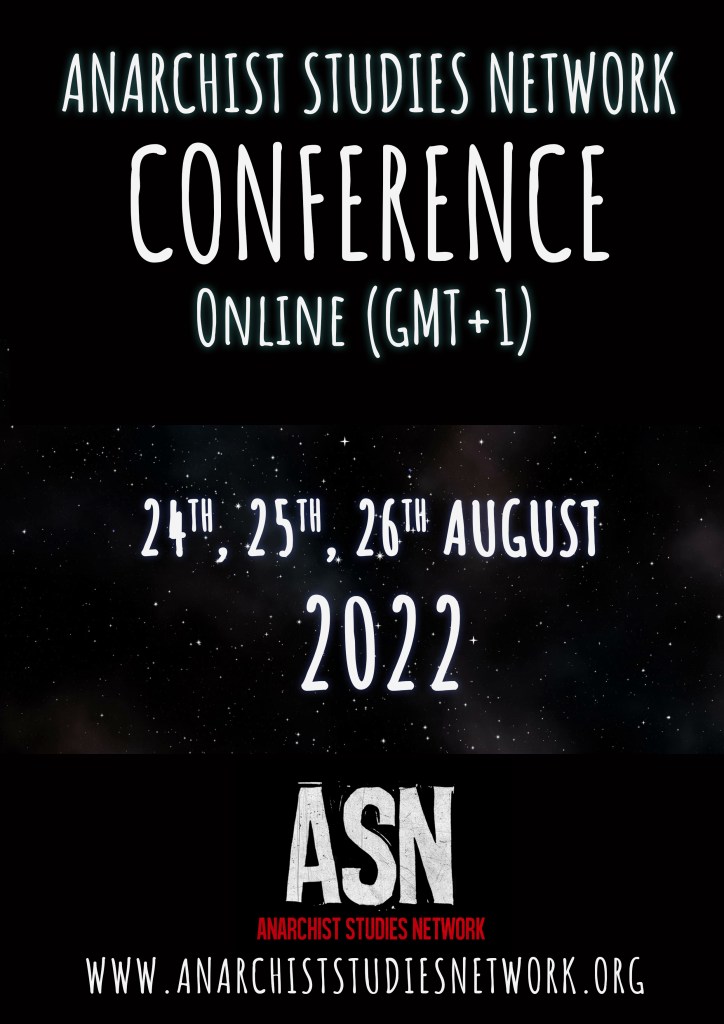
The 7th International Conference of the Anarchist Studies Network will be held as an online event on 24th-26th August, subject to change to hybrid if we find a suitable location. ASN conferences aim to broach new frontiers in anarchist scholarship and encourage cross-pollination between disciplines. We also invite people who don’t usually reside in or feel comfortable in academia to do workshops, talk about their work, projects, plans and build connections.
The central theme for this conference is Anarchist Futures. A list of suggested topics includes, but is not limited to, the following:
- How do we imagine the future? What does an anarchist society look like?
- How do we imagine a world without prisons, the state or police?
- How did anarchists in the past imagine the future? Did we get there?
- How does literature and art envision an anarchist future?
- How do we act for the future now?
- What is needed to change the future?
- Who are the actors of change?
- What is the role of imagination in changing the world?
- What is the relationship between anarchist theory and the future?
As usual, ASN also welcomes submissions that do not reference the main topic but are related to anarchist theory and practice. We also welcome panels and streams on a particular topic. We particularly welcome submissions outside the traditional academic format, such as performances, exhibitions, workshops, among others. We are happy to accommodate papers in any language, but please send an abstract in English. Please indicate whether you want to present online or in person. Abstracts should be sent by 30 April 2022 to asn.conference@protonmail.com
We aim to facilitate and accommodate all accessibility needs, including but not limited to wheelchair access, hearing loops, quiet rooms, child-care and material support for low-waged participants. Please do get in touch with any specific questions, needs or comments and we will do our best to meet them.

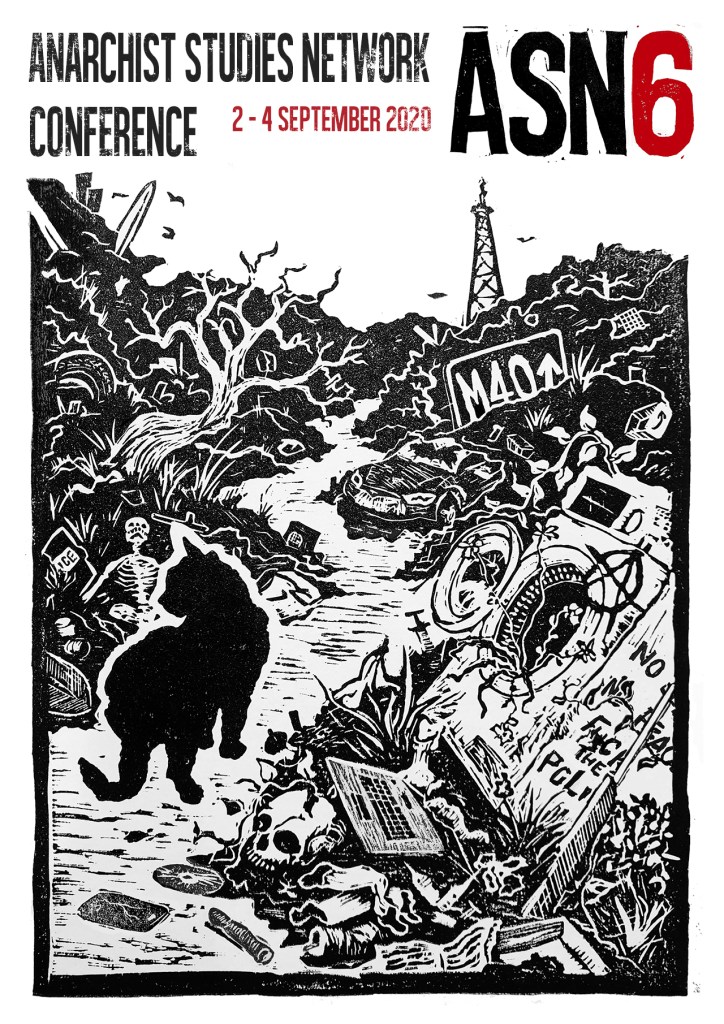
ASN6: Anarchist Studies Network Conference 2020
ANARCHY IN CRISIS – 2nd to 4th September 2020
This year’s international ASN conference will be held online over the Hopin platform. Registration is now open.
We have a discord channel for attendees and members of the ASN so if you would like an invitation to join, or have any other queries please email asn.conference.6@mail.com.
In the meantime, check out the Anarchist Studies blog, the Anarchist Studies journal and the Anarchist Research Group (ARG) on Twitter and YouTube. Please also read our Code of Conduct.
Look forward to seeing you there!